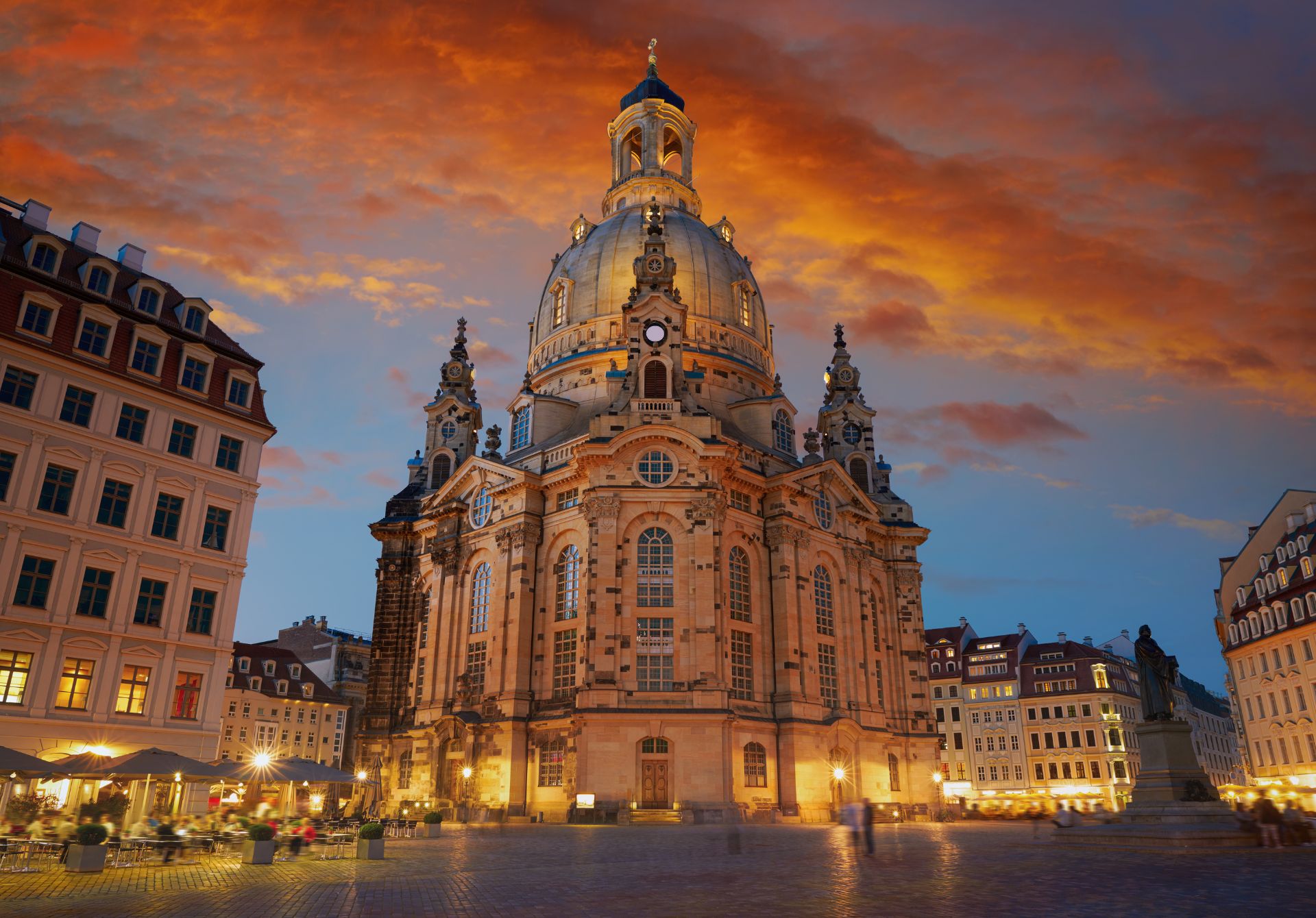
Standing majestically in Dresden’s historic center, the Frauenkirche (Church of Our Lady) isn’t just another pretty church on your European tour – it’s a powerful symbol of reconciliation, architectural brilliance, and human resilience. Whether you’re a history buff, architecture enthusiast, or simply someone who appreciates a good comeback story, this stunning baroque masterpiece deserves a prime spot on your Dresden itinerary.
The Original Marvel: Baroque Architecture at Its Finest
Let’s start with the basics that’ll make you sound smart at dinner parties. Commissioned by Dresden’s city council in 1722 and completed in 1743, the original Frauenkirche was designed by George Bähr, who created what many consider one of the finest examples of Protestant baroque architecture in Europe. The church featured a revolutionary design with an octagonal outline and square floor plan – pretty avant-garde for the 18th century.
What really set it apart was its distinctive dome, nicknamed the “stone bell” due to its unique shape. This wasn’t just for show – the dome was one of the largest in Europe at the time, a testament to both engineering prowess and artistic vision. The church could accommodate up to 1,800 worshippers, making it not just beautiful but practical for Dresden’s growing Protestant community.
The Darkest Chapter: Destruction and Remembrance
Here’s where the story takes a heartbreaking turn. On February 15, 1945, just days after the devastating Allied bombing of Dresden, the Frauenkirche’s famous dome finally succumbed to the fires and collapsed. For over 45 years, the ruins stood as a stark memorial in the heart of the city – deliberately left uncleared as a silent witness to the horrors of war.
This wasn’t just about one building; it represented the destruction of Dresden’s cultural heart. The church had survived nearly 200 years of history, only to fall victim to one of the most controversial bombing campaigns of World War II.
The Miracle of Reconstruction: When the World Came Together
Here’s what makes this story truly remarkable: The reconstruction of the Frauenkirche became one of the largest crowdfunding projects in history, long before GoFundMe was even a thing. The total cost of approximately 250 million Deutsche Marks was raised almost exclusively through donations from around the world.
The reconstruction began in earnest after German reunification in 1990, using a combination of:
- Original stone fragments: Every piece of rubble was catalogued, and about 43% of the exterior walls contain original stones
- Advanced archaeology: Detailed analysis helped architects understand exactly how Bähr had constructed the original
- Modern engineering: Contemporary techniques ensured the rebuilt structure would be more stable than ever
- International cooperation: The golden cross atop the dome was crafted by a British goldsmith, symbolizing reconciliation between former enemies
The church was officially reconsecrated on October 30, 2005 – exactly 60 years after the original consecration. Talk about poetic justice!
What You’ll Experience as a Visitor Today
Walking into the rebuilt Frauenkirche is genuinely breathtaking. The interior recreates the original baroque splendor with meticulous attention to detail. The central altar, ornate galleries, and that famous dome create an atmosphere that’s both spiritually moving and architecturally stunning.
For tourists, here’s what you need to know:
- Free entry: Unlike many European churches, visiting the main church doesn’t cost a penny
- Dome access: For €5-8, you can climb to the dome for panoramic views of Dresden
- Guided tours: Available for under €7, these provide fascinating insights into both the original construction and reconstruction
- Daily organ concerts: Short performances for around €4 – the acoustics are incredible
- Opening hours: Generally Monday-Saturday 10 AM-6 PM, Sundays from noon-6 PM (but check ahead for services)
Beyond Tourism: A Living Symbol
What makes the Frauenkirche special isn’t just its architectural beauty – it’s what it represents. Since reopening, over seven million people have visited in just the first few years, making it one of Germany’s most popular tourist attractions. But it’s not just a museum piece; it’s an active Lutheran church hosting regular services, concerts, and community events.
The reconstruction project has inspired similar efforts across Europe, from Frankfurt’s Dom-Römer Project to Berlin’s City Palace. It proves that sometimes, the most meaningful tourism experiences come from stories of resilience and renewal rather than just ancient history.
Practical Tips for Your Visit
Located in Dresden’s Neumarkt square, the Frauenkirche is easily accessible by public transport and walking from most city center locations. The surrounding area has been beautifully restored, with plenty of cafes, shops, and other attractions within walking distance.
Pro tip: Visit during one of the daily organ concerts if possible. The church’s acoustics were specifically designed for music, and hearing Bach or other classical pieces in this space is genuinely moving – even if you’re not typically into classical music.
The Bigger Picture: Why This Matters
In an age where we often focus on what divides us, the Frauenkirche stands as proof of what’s possible when people come together around shared values of beauty, remembrance, and hope. The fact that former enemies contributed to rebuilding what war had destroyed makes this more than just another tourist stop – it’s a testament to humanity’s capacity for healing and growth.
For travelers seeking experiences that combine stunning architecture, compelling history, and meaningful symbolism, Dresden’s Frauenkirche delivers on all fronts. It’s not just about checking another landmark off your list; it’s about witnessing one of the most remarkable comeback stories in modern European history.
Final thought: Whether you spend 30 minutes or three hours here, the Frauenkirche offers something increasingly rare in our fast-paced world – a moment to reflect on both human frailty and human resilience. In a city full of baroque splendor, this particular church stands out not just for its beauty, but for its story of destruction, remembrance, and ultimately, renewal.